

16 Apr Peer Observation and the Interpreter
Peer Observation and the Interpreter
By: Jordan Fox
Guest Post
I have at times been frustrated with myself and my performance when working with a colleague on a case and being overcome by nervousness that ultimately affects my performance in such a way that I’m afraid that the other interpreter will be left with an erroneous impression of my knowledge and skills. On the other hand, I often observe colleagues who could do with some advice or even corrections and I later regret not having helped my colleague avoid an error that could go uncorrected for the rest of their professional careers. Sometimes, we might feel obliged to “walk on eggshells” around certain colleagues to avoid an uncomfortable situation. What’s more, from a non-interpreter’s point of view, we might only be as good as our last interpretation. As we battle this discomfort and anxiety, we should remember that it is not in our interest to shrink from these obvious avenues to self-improvement by surrounding ourselves with a useless moat of hypersensitivity.
As interpreters, we are judged for a performance that may reflect or belie our experience and knowledge in varying degrees. Any number of factors that are not necessarily a reflection of our knowledge or skills such as the witness’s accent, an unfamiliar environment, or the acoustics of the courtroom may affect our interpretation. Our own personal lives may also play a part. For example, our sleep may have been disrupted the night before, we might be concerned about a close family member, we might not be feeling well, or we simply did not have time to drink our morning coffee. What’s more, we may go through periods in our professional lifetime where we have more time and a greater desire to further our knowledge, improve our skills, or simply rest on our laurels. Both the observer and “observee” should be aware of these factors and not rush to judgment regarding one’s skills or knowledge. We should consider this observation an opportunity to improve or even reignite our interest in engaging in research, something we might not have done since taking classes years ago.

An interpreter engaged in efficient notetaking, accompanied by a warm cup of coffee
If an interpreter chooses to be observed, I propose that he have the option of choosing who is going to be his observer. When we work in the same courthouse day after day, we might perceive different strengths and weaknesses among our colleagues and different proceedings might require different knowledge or skills. Some interpreters might excel in a proceeding replete with complex legal arguments because their stronger language is not English, or most of their formal education was in another country or simply because they excel at non-English simultaneous interpretation. If observation is mandatory, interpreters should be able to choose the colleague or colleagues who will observe them even if they’ve mutually agreed to present an excessively positive report in advance. The point is for the interpreter to grow accustomed to being observed and, eventually, to receiving some constructive criticism. Allowing interpreters the freedom to select the observer may be a more productive choice than observation by a supervisor who might be too busy with administrative duties or have less experience/knowledge than the subordinate he or she is observing. Additionally, if interpreters have the option of being observed by more than one person, this approach may yield a more balanced assessment.
Interpreters may also want to avail themselves of the option to observe their colleagues. Obviously, permission should be asked beforehand. If you feel you might have some helpful observations to offer the person observed, you might want to ask the other interpreter if she would like your input. She might not.

Effective communication and collaboration are key to successful teamwork
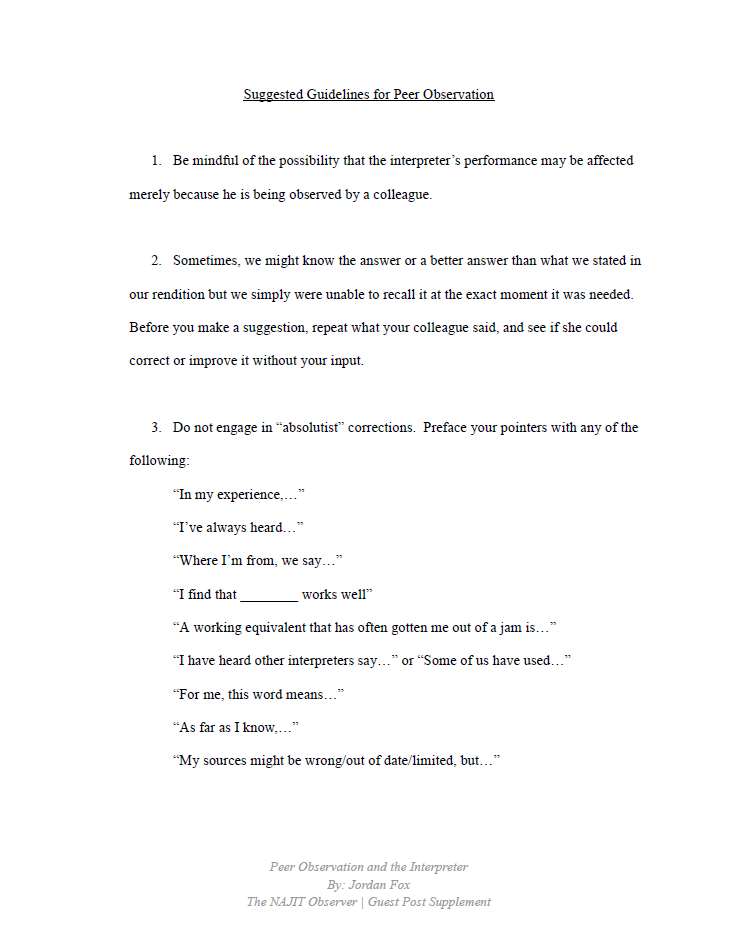
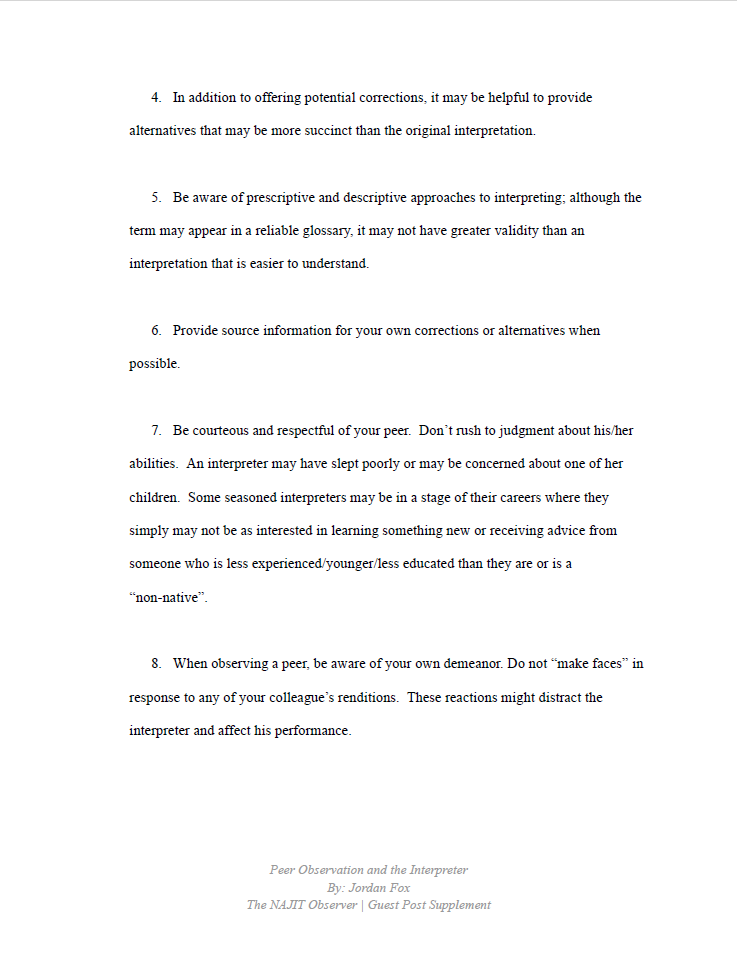
I propose that the observing interpreter review the “Rules for Peer Observation” each time before engaging in this exercise. The observing interpreter should write down any passage that she finds erroneous or long-winded or just strange and, if possible, provide an alternative. Once the observation has concluded, the observed interpreter should have the option to submit it to his/her supervisor or not. As stated, the idea is to get used to being observed and ultimately, critiqued. Ideally, any interpreters who choose to abuse or bypass this process will ultimately conclude that they are simply undermining and hindering their own professional development by avoiding this opportunity for improvement.
Finally, it might be in the observee’s interest to choose an observer with whom the former does not have an amicable relationship. Daniel Kahneman in his book, Thinking Fast and Slow, found that colleagues who liked each other also formed favorable perceptions of each other’s work performance. A more courageous interpreter might choose a colleague who does not inspire great affection or maintains a certain distance to provide a more genuine assessment.
In a legal environment where any proceeding may extend beyond expectations, an interpreters office might habitually hire more interpreters than what would appear to be initially necessary in order to always have interpreters available. I’m sure many of us have found ourselves with nothing to do, especially later in the afternoon. This assessment would be a constructive way to spend these idle hours. Indeed, prosecutors and defense attorneys come and observe their colleagues at hearings and trials. If we compare our rather performance-based profession to other similar ones, we’ll see that the actor has his fellow actors, director and audience to provide feedback. A professional athlete has other players, his coach and a stadium full of observers to guide him. A musician also has an audience yet we interpreters go it alone…to our detriment. Let’s make peer observations part of our job duties and work together to improve ourselves and others.
See Suggested Guidelines_Peer Observation, and let us know what you think
and if there is anything you would change?
Keep the Conversation Going
If this topic resonated with you, be sure to check out our previous blog posts for more insights on the realities of our profession, and the evolving world of judiciary translation and interpreting:
I find it more than a bit disturbing that we, as professionals, believe we can neglect to correct ourselves or a colleague who has made an error in interpreting. The guidelines of team interpreting and our code of ethics require us to do so for a substantial error. When we neglect to follow through on this, we are doing a disservice to the court and the LEPs and are not ensuring complete and accurate interpretation. It is not enough for us to sit on our laurels. We have to strive to continually improve.
I loved your article. Thank you for sharing this thought-provoking and insightful proposal.
The article raises an important point about the need for feedback in a profession that often operates in isolation. Encouraging peer observation is a constructive step, particularly in environments where performance is both immediate and consequential.
At the same time, what is being described closely resembles mentoring. Whether formal or informal, these processes are most effective when guided by clear frameworks and shared criteria. In other professional settings, feedback is not based on individual impressions alone, but on structured evaluation methods that promote consistency and accountability.
Equally important is the foundation of the feedback itself. Observations grounded in personal preference or anecdotal usage can introduce inconsistency rather than improve accuracy. In legal interpreting, feedback should be anchored in verifiable sources such as statutory language, established terminology, and jurisdiction-specific usage. This ensures that suggested alternatives reflect not just familiarity, but precision.
The emphasis on collegiality and respect is well placed. However, professionalism in feedback also requires rigor. It is possible to offer clear, evidence-based input while maintaining a respectful tone.
Peer observation can be a valuable tool for professional growth. Its effectiveness will depend on incorporating clearer evaluative criteria and grounding feedback in authoritative sources, particularly in a field where linguistic choices carry legal consequences.
Speaking as a AOUSC, New Jersey & California Certified interpreter (now retired) with over 20 years of experience working in U.S. courts, I feet the need to comment on your article because I believe it highlights what I perceive to be a common problem amongst court interpreters, namely; that of extreme obsequiousness. The reason for such abject servility in our chosen profession, as expressed for example in your article, seems to be the overriding need to deliver the perfect ‘performance’ for the ‘observer’. The main ‘observer’ we seem to most worry about is always, in one capacity or another, a functionary of the State such as a judge, prosecutor or attorney. Yet this need to hold oneself to the highest standards is not shared by the State itself. Not at all! If in doubt, simply pick up a newspaper and peruse the latest news. The simple fact is that the U.S. has no rule of law whatsoever. It hasn’t had it for quite a while. This is not a political statement, it is a factual reality. So while you fret sleepless nights worrying about whether you can hold yourself to the highest standards, the people you work for have absolutely no standards at all. None! Unless of course one considers making money to be a standard. Additionally, the State could not care less about your ‘performance’. The only thing the State desires is your subservient compliance, that you do the CE classes and that you pay the renewal fees! Otherwise, please keep out of sight! Make no mistake about it, if the State’s courtroom pecking order could be compared to that of a restaurant, interpreters would be the food servers. If not the busboys. Any court interpreter capable of leaving their fragile ego aside for even a minute will recognize the truthfulness of this statement.
In his seminal work Propaganda (1928), Edward Bernays articulated that democratic society is, by necessity, managed by an unseen elite who mold public opinion and dictate behaviors. As someone who has lived in this country for over 4 decades, I have seen the constant application of Bernays’ methods in all aspects of daily life, but perhaps never more so than when I worked for the courts, due to the up-close view it allowed me of its fundamentals. To quote the late, great George Carlin, “It’s called the American Dream because you have to be asleep to believe in it.”
If anything, the sentiments and concerns expressed in your article showcase the veracity & even ultimate success of Bernays’s thesis regarding psychological manipulation. I kindly invite you to wake up.
Great comment and great take. Thank you.
Well done, Jordan!
I retired from court interpreting after 30 years, most of them in federal court. If you’re doing consecutive work with a partner, you are de facto under observation and that’s as it should be. It used to make me a little uncomfortable; because of my fragile ego, but i knew it was a good thing and welcomed it.
Indeed i enjoyed working with none other than Jordan a few times. He is a superb interpreter.
Excellent article, Jordan!
I wholeheartedly agreed with your position. It’s incredibly helpful to be observed and be given an objective assessment of our interpreting performance. We provide a vital service and should never take our skills for granted. One of the best parts of this line of work is that we learn new things every day and have the opportunity to constantly improve. Peer review helps us do that.
I am eternally grateful to the Spanish interpreter who showed up to relieve me during a hearing, and noticed a gramatical mistake I made before she took over. I feel as though I have studied the subjunctive all my life, but this was a use of the subjunctive that had somehow escaped my attention. She mentioned it to me later in a friendly and helpful way. Thank you Jordan Fox for bringing up an interesting and important topic. Can you observe me some time?
I really do not think having an interpreter with whom you do *.not* have an amicable relationship provide critical feedback is viable in practice.
Very good points. Thank you for this.