

28 May Be a Swan, Not a Duck
Be a Swan, Not a Duck
By: Ann (Jiraporn) Heath-Huynh
A recent discussion with a colleague, a fellow NAJIT member, prompted me to think more carefully about how interpreters must “hold it together” even when they feel close to succumbing to pressure. The feeling that I have experienced myself even as a seasoned interpreter. My colleague spoke about one of the presentations given at the NETA¹ conference, where the lecturer² presented under the topic “Reimagine Visibility: From Booth to Screen.” While the presentation was geared more towards conference interpreting, it was also relevant to court interpretation. Court interpreters must maintain decorum in front of a courtroom audience while being exposed to multiple stress factors. In some cases, there are more than just the officers of the court and counsel. High stake cases can come with a gallery filled with the press and spectators.
 While cognitive load and speed is an overlapping area where legal interpreters may share with conference interpreters, one of the challenges in interpreting in the courtroom is overlapping conversation on top of the speed. Furthermore, rendering language with precision and conveying jargon is not optional, but a requirement that can lead to ethical dilemmas if not followed precisely. Another element that can add to a court interpreter’s ability to “hold it together” in public, that may not get discussed frequently enough, is vicarious trauma.
Court interpreters must interpret graphic details of crimes, abuse or tragedies without allowing their own emotions to compromise their impartiality. Prolonged or repeated vicarious trauma can significantly affect an interpreter’s mental health and overall well-being. Interpreters who are regularly exposed to distressing narratives—such as accounts of violence, abuse, war, persecution, medical emergencies, or traumatic loss—may gradually absorb the emotional weight of those experiences even though they are not the direct victims.
The aforementioned items are a few of the stress factors that court interpreters must endure. As someone who interprets in both settings (conference and legal) I can attest that the act of having to “hold it together” really exists, and is important.
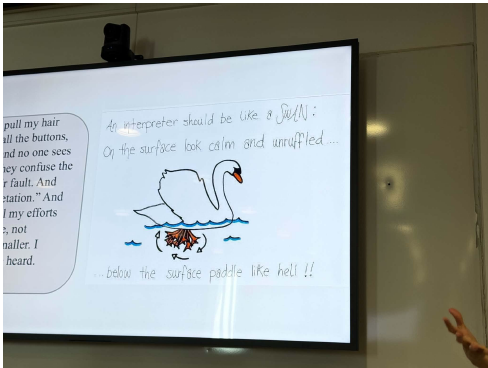 The presenter in this case, Ms. Ozum Arzik-Erzurumlu, Ph.D, used the analogy of a swan, a graceful creature that glides over the surface of the water with poise and calmness. No one knows if there are any struggles beneath that water. In her presentation, she graphically illustrated the concept in a way that was so clear to those who saw it. As someone who did not have the pleasure to listen to her firsthand, I understood the idea as soon as I saw the drawings. It was such a brilliant observation that was easy to relate to. I liked this concept so much, I emailed to ask her permission to write about it.
Interpreters are often expected to remain calm and composed even when they are internally struggling with stress, emotional exhaustion, or difficult input that is challenging to process. In many settings, interpreters must continue facilitating communication accurately and neutrally despite hearing distressing stories or witnessing intense emotional situations. This outward calm is usually not a sign that they are unaffected. Rather, it is a coping and professional performance strategy developed through training, experience, and repeated exposure to stressful environments. Many interpreters learn techniques such as controlled breathing, emotional compartmentalization, focused listening, and maintaining attention on accuracy and task completion instead of their personal feelings in the moment.
Developing strong interpreting skills also means developing sustainable coping strategies. Regular debriefing, continued training, mindfulness practices, and community support can help interpreters protect both their accuracy and their mental health over time.
 (Excessive) preparation is also one tool that I personally use to calm what I call my “inner bunny,” where my heart bounces up and down, like a bunny hop. Knowing that you know your subject/ material can reduce stress and empower you when faced with situations where you feel like you are in survival mode.
However, this should not be conflated with a lack of professionalism arising from avoidable or self-inflicted circumstances. During my most recent conference assignment, an interpreter from another booth was complaining that the client never gave her any information or vocabulary list for the event and it was extremely frustrating. The client was a large company that is publicly known and has information on nutrition that basic terminology could have been researched within seconds. As professional legal or conference interpreters, and as responsible adults, we should take a proactive approach before accepting or entering into any assignment. This includes preparing thoroughly, understanding the subject matter, clarifying expectations, assessing potential challenges, and ensuring that we are mentally, emotionally, and professionally equipped to carry out our responsibilities effectively. Professionalism requires not only linguistic competence, but also composure, foresight, and accountability in managing situations before they escalate.
As Dr. Ozum Arzik-Erzurumlu, Ph.D said, “Colleagues, be a swan (not a duck). May grace and composure always be with you.”
The author was granted permission to discuss and reference the presentation discussed in this article.
References
-
-
- New England Translators Association
- Ozum Arzik-Erzurumlu, PhD
-
Keep the Conversation Going
If this topic resonated with you, be sure to check out our previous blog posts for more insights on the realities of our profession, and the evolving world of judiciary translation and interpreting:
The images used in this post are sourced from Unsplash, Pixabay, AI generated, and/or credited to their rightful owner. They are used for illustrative purposes only.
The views and opinions expressed in this post are those of the author(s) and do not necessarily reflect the official position, policies, or views of the NAJIT Board of Directors or the organization as a whole. Content published in The NAJIT Observer is intended to encourage professional dialogue, reflection, and community engagement. Reader discretion is advised where topics may involve complex ethical, professional, or emotionally sensitive subject matter.

A professional portrait of a smiling woman exuding confidence and warmth
Ann (Jiraporn) Heath-Huynh
Blog Writer
Hi, all, I’m Ann (Jiraporn) Heath-Huynh, and I grew up in a bilingual Thai-English household, seamlessly navigating both languages from an early age. Living on four continents has shaped my global perspective, but the U.S. is where I now call home. My journey in the language field began after the birth of my daughter in 2010, evolving from a part-time job into a career I deeply love. Since joining the Maryland Judiciary’s roster of interpreters in 2015, I have embraced various opportunities, including Department of State Conference Interpretation for Thai and English. Although I primarily work as a conference interpreter, I hold a special connection to Maryland courts, where I’m proud to accept assignments and wear my first-ever interpreter’s badge. I’m eager to share my experiences and insights to enrich and inspire our professional community.