

29 Jan On Verbatim
On Verbatim
By Ángeles Estrada, M.A., F.C.C.I.
Verbatim is a Latin expression that means “word for word,” and it is the golden rule for court-reporters whose charge it is to preserve the record. But, what about court interpreters?
An interpreter’s oath is different from the court reporter’s oath. We are sworn to “render accurately and faithfully.” And it could not be otherwise, for we are going into a separate language.
“Verbatim (word for word) interpretation is not the goal of the court interpreter, although it is a common misconception [. . .]. Not only is word-for-word, or literal interpretation, impossible because of the lack of one-to-one correspondence in word equivalence between languages, but it usually distorts the speaker’s meaning and misrepresents actual testimony.”1
“A verbatim or literal translation can yield an almost meaningless product.”2
Our rendition is conceptual verbatim. As an example, the expression “sticky fingers” (meaning someone with a propensity to steal) in Spanish would be “mano larga,” which says nothing about fingers nor stickiness.
 However, court interpreters cannot disregard the emphasis that judges place on verbatim. It is a reminder of the demand for exactness this profession requires, as compared to other interpreting fields. Court interpreting involves a meticulous attention to detail that must be exercised with utmost diligence.
Unlike the court reporter, our oath also requires that we preserve what are called “paralinguistic elements, such as hesitations, false starts, hedges, and repetitions […] in the corresponding points of the target language,”3 for they have a bearing on the credibility of the speaker. We keep flippant tones. A disrespectful “yeah” is not preserved by the court-reporter in the record, which may only show the informal form of “yes,” but an interpreter’s duty is more immediate, and specifically for the ears of those present in the courtroom, though they may balk.
“Interpreters are obliged to mirror the voice of the defendant or witness by transferring the message … as it was originally spoken.”4
We must be familiar with idioms in both languages. When a judge asks the defendant, “Why did you do it?” and he responds “Fui un inconsciente,” it does not mean he was unconscious, but rather “I didn’t think it through” or “I was blind,” as in the song “A veces fui” by Mexican singer-songwriter Aleks Syntek. “Estar inconsciente” (be unconscious), and “ser un inconsciente” (follow a blind impulse) are as diametrically opposed as the verbs “ser” and “estar” are in Spanish, no matter that in English both translate as “to be.”
Conversely, even when providing the idiomatically equivalent, we sometimes make less-than-appropriate choices. The question “Have you had an opportunity to review the pre-sentence report?” simply asks the defendant whether he has in fact seen and reviewed the report. If the interpreter states “¿ha tenido tiempo de ver…?”, she is introducing a new element: “have you had time,” which invariably makes the defendant grumble about feeling rushed. Judges, particularly if they are conversant in both languages, will pick up on this issue immediately. It does not matter that, colloquially, we say in Spanish: “ha tenido tiempo . . .,” and mean nothing by it, other than to give the other party an out if they had neglected to do something. In court, our word choices do matter.
A seasoned interpreter is aware of these pitfalls and avoids them. There is no excuse to be sloppy with recurrent expressions, and a hesitation on the interpreter’s part with phrases that come up often may undermine her credibility with the Court.
As language professionals, we are cognizant of the requirements of our job and must appraise the Court of language issues that may not be apparent. Clarifications by the interpreter from the witness are sometimes necessary to provide the correct rendition. The same expression can mean different things regionally. A large sign above a store reads: “Ya abrimos.” This in Spain translates as “we are already open for business;” while in Mexico it is: “opening soon.”
The interpreter has a duty to alert the Court as to how a literal rendition may skew testimony.
In a capital murder trial, when answering how the victim was found, the witness for the prosecution stated: “estaba agonizando.” The on-duty interpreter translated the statement literally as “she was agonizing.” However, after consulting with the stand-by interpreter, the record was corrected to: “She was dying.” Agonizando, in Spanish, means simply “dying,” without any implications of tortuous death, which might have added aggravating elements to the killing.
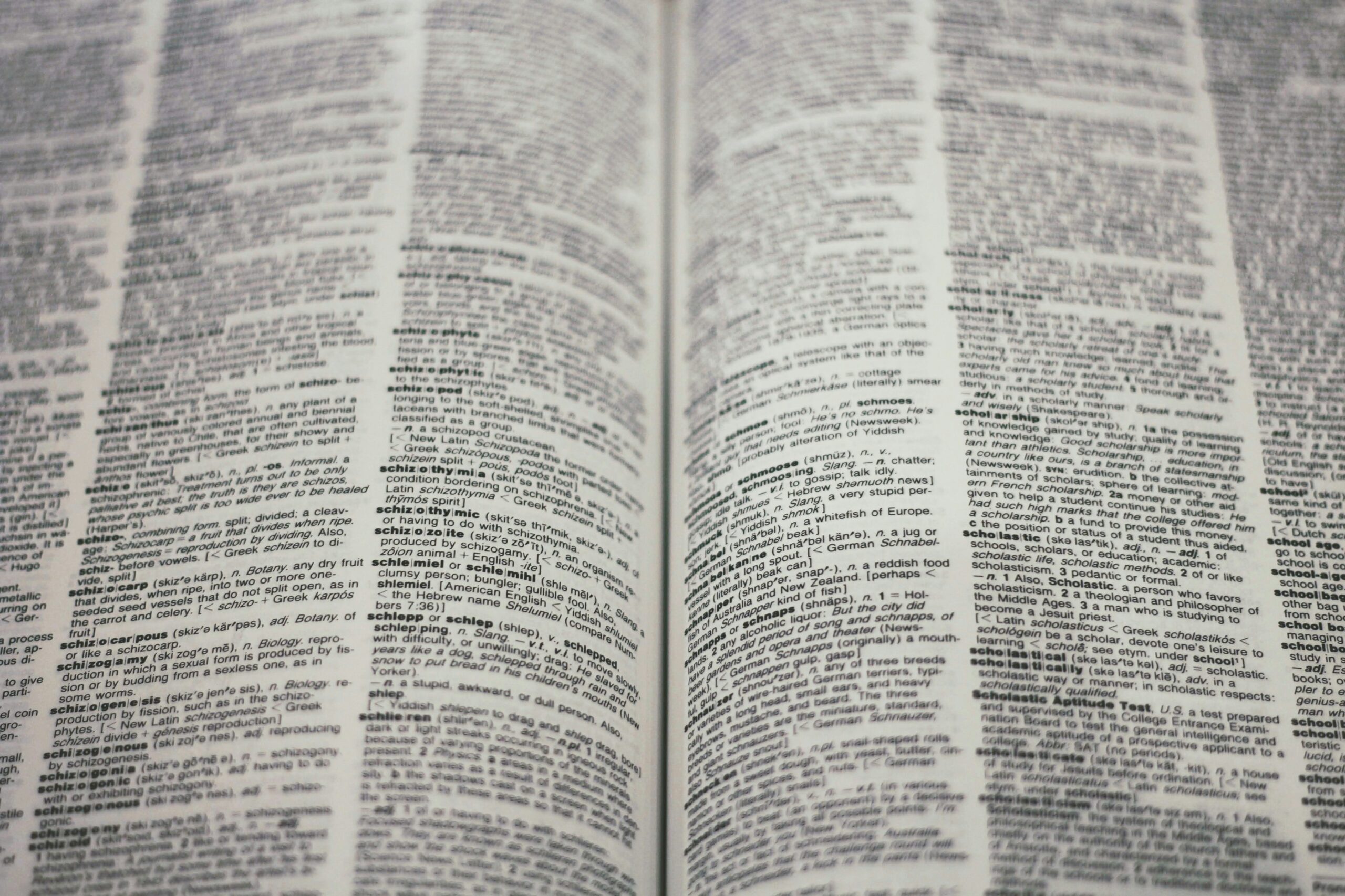
A dictionary: a vital tool for interpreters and translators in navigating linguistic precision
Translation and interpreting usually require syntactical transpositions and grammatical adjustments. One could argue that English and Spanish are not so different for our rendition into the target not to mirror the source, except for the dreaded false cognates and those pesky idiomatic expressions. “Palabras mayores” is not “big words;” it means “serious talk.”
However, language is not a preordained word arrangement, a catalogue of terms, or a series of static equivalencies. Similar sentence constructions and words are not necessarily the better choice, and no translator or interpreter worth her salt would choose her rendition on that basis.
The ability to capture and convey meaning in split-second decisions rests not just on the interpreter’s capacity to parallel process, her cultural sensitivity, and language knowledge –– whether academic, field-specific, or conventional usage. What is most important is the interpreter’s freedom to reach for and make language choices that communicate readily and accurately. What we do when interpreting is almost intuitive; and if the immediacy of that process is constrained and interfered with by requirements of unduly adhering to form, meaning will suffer.

When justice speaks, it echoes with power, purpose, and responsibility
In a written text (translation), the language professional has the time to carefully ponder, research, abridge, and formally adhere to the source. In interpreting we are flying by the seat of our pants, communicating in a more organic and less contrived way, and prioritizing content. However, interpreting is not less accurate than translation. Rather, interpreting has the clear advantage of better capturing the source, because the interpreter is context-immersed and has additional input from tone and body language, as well as the opportunity to ask for clarification.
Having said this, neither the written nor the spoken medium is preferable to preserve the source when moving into a foreign language, or the other way around. In either case, the target must be fashioned to read/sound natural and fluid, with as little tell-tale as possible of the language transference, so there is no disruption to the thinking process of the receiving public. The result should be clearly understood.
In 1999, Holly Mikkelson wrote Verbatim Interpretation: An Oxymoron, which was not published at the time and only came out in 2021. In it, she states that “There is an inherent conflict between the legal profession’s expectation of ‘verbatim’ or ‘literal’ interpretation and the standards of functional equivalency and meaning based translation.”5
Twenty-plus years later, the conflict and misconception remain, and the interpreter’s professional duty is still to be vigilant and earnest in adhering to her oath of “accurate and faithful.”
-
-
- Roseann D. G., Vásquez, V. F., & Mikkelson, H. (2012). Fundamentals of Court Interpretation: Theory, Policy and Practice. Carolina Academic Press, 2nd ed., p. 17.
- Gonzalez et al. (2012). Op. cit., p. 1025.
- Gonzalez et al. (2012). Op. cit., p. 17.
- Roseann D. G., Vásquez, V. F., & Mikkelson, H. (2012). Fundamentals of Court Interpretation: Theory, Policy and Practice, p. 15.
- Mikkelson, H. (2021). Verbatim Interpretation: An Oxymoron. Acebo. Accessed at: https://acebo.myshopify.com/pages/verbatim-interpretation-an-oxymoron
-
Keep the Conversation Going
If this topic resonated with you, be sure to check out our previous blog posts for more insights on the realities of our profession, and the evolving world of judiciary translation and interpreting:
You can find these and more in our blog archives!
The images used in this post are sourced from Unsplash and/or Pixabay . They are used for illustrative purposes only.

Ángeles Estrada, M.A., F.C.C.I.
Angeles Estrada passed both her Federal Court Interpreter Exam and her Virginia certification in 1997. Before that she worked for 11 years as the official translator and interpreter for the Embassy of Mexico. She is a cum laude graduate from Loyola University, has an M.A. in Creative Writing from GMU, as well as translation certificates from Georgetown University (in both directions). She lectured in translation at Georgetown (3 semesters), as well as in translation, sight translation, and writing at UMD (two semesters); has been qualified by the State Department as a seminar interpreter and translator (also in both directions), and is ATA accredited. Ms. Estrada has previously published in The Jerome Quarterly, and The Chronicle.
A wonderful and well-laid out piece on the topic. I enjoyed it greatly. Your point about judges stating that we are to interpret verbatim made me reflect upon what they view as “verbatim“. I will have to ask the judges I work for if they share the same expectation as the one judges you have worked with. I will readily show them your article; it will serve as a great clarification selling point, if you will. Thank you, Angeles.
Agree with Plunkett’s positive commente about your blog Effective and important reminders.
I am not an interpreter or translator but am an applied linguist working as an expert consultant/ witness in legal cases involving non-native speakers (NNSs). I have to listen carefully for possible misbeliefs that factfinders (judge & jury) might have about a NNS’s language proficiency and how this might affect content being communicated.. Frequently my testimony is being interpreted. and occasionally i see court reporter scripts of my testimony.–or the testimony of others. Also I need to respond to challenges regarding a suspect’s language proficiency..I need to be sensitive tor the issues mentioned in the blog.
Excellent article. Thank you, Angeles, for providing such detailed points on the nuance involved in the interpreter’s job – cultural, regional nuances, and what I call “linguistic habits”, that affect how the same word in the source language can be used differently in different regions, sometimes even having no meaning at all. I was asked once by an attorney, who claimed to be fluent in Spanish, to provide a more “verbatim” interpretation of his client’s testimony during a deposition during a break. His witness used many idioms in her speech, which required that I use meaning-equivalent idioms in English. After much insistence on his part, I humored him by interpreting “verbatim” what she said. He immediately realized that what she was communicating in Spanish through these colloquial phrases made absolutely no meaningful sense in English. He then understood….
Angeles, may we share this article in Social Media (providing credit to the author, of course)? This article should be read by attorneys and judges alike. Thanks, again, for your thoughtful analysis!
Ezequiel, yes of course, use it as you see fit. And thank you for your kind comments.
Best,
Ángeles
Ángeles, this is an excellent article, particularly for its clear, practical examples and for how effectively it highlights the exacting nature of the work we do.
With your permission, I will be sharing it with my network.
Thank you.
Lovely piece, Ángeles. Quite useful and superbly written.
Once again Ángeles Estrada is doing the heavy lifting! The “verbatim” issue is TOUGH, but your article carefully teases out what it means to be “cognizant of the requirements of our job,” gives concrete examples for reference, and provides beautiful phrasing for how to professionally “appraise the Court of language issues that may not be apparent.” Very helpful. Thank you, Ángeles!