

17 Dec Can Translation Be the Only Route?
Can Translation Be the Only Route?
Julli Jaramillo
In our last conversation on Judiciary Translation vs. Judiciary Interpretation: Which Path Resonates with You? We explored the question many of us encounter early on: which path should I choose? The responses, both spoken and unspoken, pointed to a familiar conclusion. For many of us, the answer is not either-or.
We translate and interpret.
We translate and teach.
Translate and edit.
A myriad of overlapping roles.
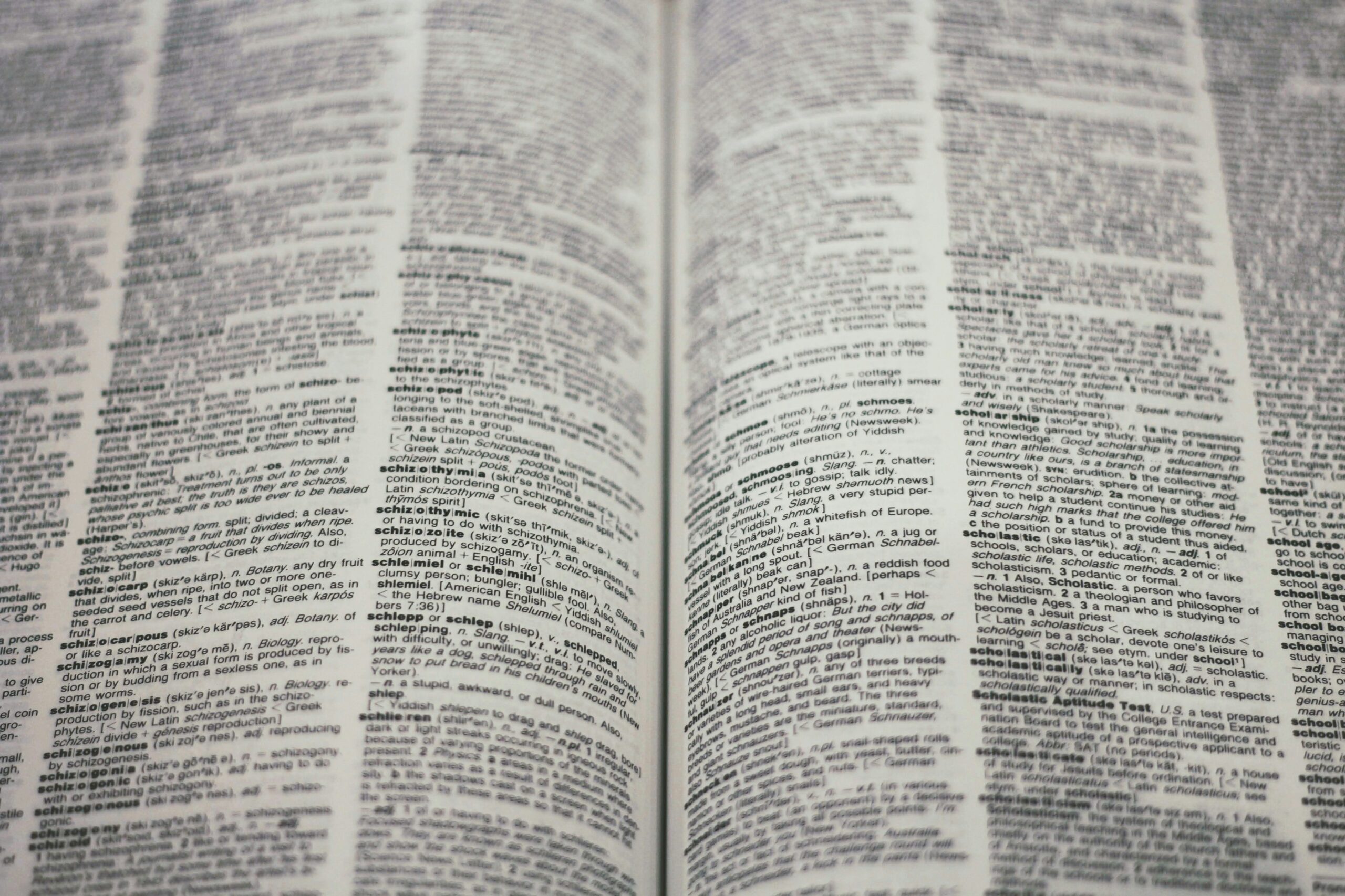
A dictionary: a vital tool for interpreters and translators in navigating linguistic precision
We move between modalities as work, opportunity, and sustainability requires.
That discussion, however, opened the door to a deeper question, one that deserves its own examination: if many of us do both, what does that say about each path on its own? More specifically, can translation function as a standalone profession, or has it become something that must be supplemented to remain viable?
I want to be clear about my position in this conversation. I am a legal translator by training, and this piece is written from within that practice, not at a distance from it. I am not arguing for one modality over the other, nor am I suggesting that interpretation is optional or secondary. Rather, I am using translation as the focal point because it is the work I know most intimately, and the lens through which I experience questions of sustainability, specialization, and professional identity.

Accurate interpreting is critical to due process, ensuring fairness in the courtroom.
If we are honest, most of us have already answered part of this question through our own career paths. Very few decisions in this field are made in a vacuum. They are shaped by volume fluctuations, institutional expectations, physical and cognitive demands, and the reality that language work does not exist outside of economic, social, and/ or technological pressure (to name a few). The choice to combine roles is often framed as flexibility, but it is just as often a response to constraint.
Translation, in particular, occupies an interesting position. It is quieter work. Less visible. Less immediate. Its impact is often felt long after the document leaves our hands, when accuracy, tone, and intent either hold up under scrutiny or fall short. Unlike interpretation, translation rarely comes with the same sense of urgency or public acknowledgment, yet the liability is no less real. A mistranslated clause, a misrendered concept, a missed register can carry consequences that ripple far beyond the page.
And still, many of us love this work.
We love the precision. The problem-solving. The deep familiarity with legal systems, terminology, and structure. The satisfaction of getting it right when there is no margin for error. For some, translation offers a kind of intellectual steadiness that interpretation does not. For others, it provides distance from the emotional intensity of live proceedings. These preferences matter, yet they are rarely centered when we talk about sustainability.
The unspoken assumption often becomes that interpretation is where stability lives, while translation is something to be folded into a broader portfolio. But that assumption deserves interrogation. Not because interpretation and translation are in competition, but because allowing one modality to be quietly framed as supplementary shapes how work is valued, priced, and prioritized.
When I ask whether translation can be the only income route, I am not really asking about capability. I am asking about conditions. About access to direct clients, specialization, jurisdictional demand, institutional procurement models, and how much professional risk one is expected to absorb individually. These are structural questions, not personal shortcomings.
So, what do you think? And to add more spark, if in a perfect world you could choose either modality as a true standalone profession, without economic penalty or institutional distortion, which would you choose and why?
That answer, collectively, may tell us more than any market analysis ever could!

A radiant and confident portrait of a woman embracing bold style and elegance
Julli Jaramillo is the Publishing Coordinator and Editor-in-Chief for NAJIT. She holds a master’s degree in Translation from NYU and has extensive experience in quality assurance, content development, and strategic growth. Passionate about NAJIT’s mission to uphold ethical standards for judiciary translators and interpreters, she is dedicated to driving the organization’s growth while ensuring its publications meet high-quality standards and adapt to evolving industry demands. In her free time, Julli enjoys baking and creating art.
Feel free to reach out to her (editor@najit.org) to chat about the NAJIT Observer or Proteus—she is excited to collaborate!
Keep the Conversation Going
If this topic resonated with you, be sure to check out our previous blog posts for more insights on the realities of our profession, and the evolving world of judiciary translation and interpreting:
-
- Let’s Test Your Ethics: Confidential Conversations — An ethical scenario on confidentiality, responsibility, and professional boundaries.
- Going out with a Bang! — A tribute honoring Rob and Susan Cruz and the decade of leadership, stability, and community-building they brought to NAJIT.
- The Couch: New Member to NAJIT — A new NAJIT member reflects on the uncertainty of stepping into an established professional community and asks how others found connection, confidence, and belonging within NAJIT.
You can find these and more in our blog archives!
The images used in this post are sourced from Unsplash. They are used for illustrative purposes only.
What I like about translation is how it makes me a better interpreter; what I love about interpreting is the fact that once you’re done with delivery you’re done with the job, out of sight, out of mind. Translation tends to rent space in my mind and stay there for days, sometimes even after I deliver a job it comes back to haunt me. Oh, THAT’s the word I should have used… Now, I consider myself an interpreter first, translator second, or even third. Now, both professions are probably on AI’s kill off list. But I think translation will go (or is going) first. Who knows for how long translation alone will remain a viable option for survival?